Tesamorelin and ipamorelin are two of the most commonly researched growth hormone-related peptides, but they represent fundamentally different categories of GH axis research tool. Tesamorelin is a GHRH analogue — it acts at the growth hormone-releasing hormone receptor on anterior pituitary somatotrophs. Ipamorelin is a GHRP, or growth hormone-releasing peptide — it acts on a completely different receptor, the ghrelin receptor (GHSR-1a), on the same cells. Understanding this distinction is essential for researchers selecting compounds for GH axis studies, designing combination experiments, or interpreting published pharmacodynamic data.
This article provides a research-focused comparison of both compounds: their molecular structures, receptor targets, selectivity profiles, pharmacokinetics, and how researchers use each one. Neither compound is for human or veterinary administration. All material pertains to preclinical and in-vitro research contexts.
The Growth Hormone Axis: Two Entry Points
To understand why tesamorelin and ipamorelin are distinct research tools, it helps to map the two upstream inputs that drive pituitary GH secretion. The hypothalamus produces two hormones with opposing effects on GH release:
- GHRH (growth hormone-releasing hormone): a 44-amino acid peptide released from the arcuate nucleus that stimulates GH synthesis and secretion by binding to GHRH receptors (GHRHR) on anterior pituitary somatotrophs via a Gs/cAMP pathway
- Somatostatin (SRIF): a peptide that inhibits GH secretion by binding to somatostatin receptors on somatotrophs, opposing GHRH's stimulatory effects
Separately, ghrelin — a 28-amino acid peptide produced primarily by gastric oxyntic cells — acts on the ghrelin receptor (GHSR-1a) expressed on both hypothalamic neurons and pituitary somatotrophs. GHSR-1a agonism stimulates GH release through a Gq/phospholipase C/calcium-dependent intracellular pathway, independent of the GHRHR/cAMP pathway. Ghrelin also suppresses somatostatin tone at the hypothalamic level, further amplifying GH secretion.
Tesamorelin targets the first of these entry points — the GHRH receptor. Ipamorelin targets the second — the ghrelin receptor. Because they act at different receptors with independent intracellular signalling pathways, their combination produces synergistic GH release, a key principle in GH axis research.
Tesamorelin: A Clinically Validated GHRH Analogue
Tesamorelin is a synthetic analogue of the full 44-amino acid human GHRH sequence, modified by the addition of a trans-3-hexenoic acid group conjugated to the N-terminal tyrosine residue. This modification confers resistance to DPP-IV cleavage at the Ala-2 position, which is the primary site of native GHRH degradation in plasma. The result is a compound that retains the full biological activity of GHRH at the GHRHR while offering substantially improved plasma stability compared to the native hormone.
Tesamorelin's plasma half-life is approximately 26-38 minutes — significantly longer than native GHRH's 2-4 minutes but short enough to produce a defined GH pulse rather than sustained non-pulsatile elevation. This makes it suitable for both acute pharmacodynamic studies and repeat-administration protocols where pulsatile GH profiles are the research objective.
A key pharmacological feature of tesamorelin is its selectivity profile. Unlike some older GHRH analogues, tesamorelin produces GH stimulation without meaningful effects on cortisol, ACTH, prolactin, or thyroid-stimulating hormone at research-relevant doses. This hormonal selectivity means that GH-mediated endpoints observed in tesamorelin research can be attributed specifically to GH pathway activation rather than confounded by concurrent HPA axis or other hormonal perturbation.
Tesamorelin in the Literature: Visceral Adiposity and GH Research
Tesamorelin has one of the most characterised clinical research profiles of any GHRH analogue. It received FDA approval in 2010 under the brand name Egrifta for the reduction of excess abdominal fat in HIV-infected patients with lipodystrophy — a condition characterised by pathological visceral fat accumulation. This approval was based on Phase 3 randomised controlled trial data showing significant reductions in visceral adipose tissue (VAT) in treated patients compared to placebo, as measured by CT scan.
This clinical validation provides researchers with a rich literature base for tesamorelin's effects on visceral fat, GH pulsatility, and IGF-1 production. For preclinical researchers studying visceral adiposity, metabolic syndrome, or the GH/IGF-1 axis in disease models, tesamorelin is a clinically relevant GHRH analogue with well-characterised pharmacology from both animal and human studies.
Ipamorelin: A Selective Pentapeptide GHRP
Ipamorelin is a synthetic pentapeptide — a 5-amino acid compound with the sequence Aib-His-D-2-Nal-D-Phe-Lys-NH2 — developed as a highly selective growth hormone-releasing peptide (GHRP). It was first described in the late 1990s and emerged from a programme seeking GHRPs with improved selectivity over the then-available compounds GHRP-2 and GHRP-6.
Ipamorelin acts as an agonist at the ghrelin receptor (GHSR-1a), a seven-transmembrane Gq-coupled receptor expressed on both anterior pituitary somatotrophs and hypothalamic neurons. GHSR-1a activation by ipamorelin triggers phospholipase C, diacylglycerol, and intracellular calcium release — a pathway distinct from the Gs/cAMP pathway activated by GHRHR agonism. This calcium-dependent signalling drives GH vesicle exocytosis from somatotrophs, independent of the GHRH receptor pathway.
Ipamorelin's plasma half-life is approximately 2 hours — longer than native ghrelin's few-minute half-life, allowing it to produce a more sustained GH stimulatory signal during the acute post-administration window. After this 2-hour period, plasma levels decline to subtherapeutic concentrations, making each administration produce a defined acute GH pulse.
Ipamorelin's Selectivity Advantage Over Earlier GHRPs
The defining research advantage of ipamorelin over earlier GHRPs is its superior hormonal selectivity. GHRP-2 and GHRP-6, the compounds most widely studied before ipamorelin, produce meaningful increases in cortisol and ACTH in addition to GH. This HPA axis stimulation complicates mechanistic attribution in studies where GH-specific effects are the research objective, since cortisol itself has significant metabolic and anti-inflammatory effects.
Ipamorelin produces GH release with minimal to no concurrent cortisol or ACTH elevation at doses producing maximal GH responses. It also does not meaningfully stimulate prolactin or TSH. This selective profile makes ipamorelin the GHRP of choice for researchers who need clean GH stimulation without HPA axis confounding — a significant methodological improvement over its predecessors.

Key Differences Between Tesamorelin and Ipamorelin
- Receptor target: Tesamorelin — GHRH receptor (GHRHR); Ipamorelin — ghrelin receptor (GHSR-1a)
- Peptide size: Tesamorelin — 44 amino acids; Ipamorelin — 5 amino acids
- Intracellular signalling: Tesamorelin — Gs/cAMP/PKA; Ipamorelin — Gq/PLC/calcium
- Plasma half-life: Tesamorelin — ~26-38 minutes; Ipamorelin — ~2 hours
- Clinical validation: Tesamorelin — FDA-approved (Egrifta); Ipamorelin — research compound only
- HPA axis effects: Both show high GH selectivity without meaningful cortisol stimulation
- Mechanism category: Tesamorelin is a GHRH analogue; Ipamorelin is a GHRP / ghrelin receptor agonist
- Combination potential: Their distinct receptor sites make them a synergistic research pairing
The Case for Studying Tesamorelin and Ipamorelin Together
Because tesamorelin acts on GHRHR and ipamorelin acts on GHSR-1a, their co-administration targets two independent upstream inputs to the same GH-secreting somatotroph cells. The GHRHR/cAMP pathway and the GHSR-1a/calcium pathway have been shown to act synergistically on GH vesicle exocytosis — each pathway amplifies the output of the other rather than simply adding to it.
Consequently, when tesamorelin and ipamorelin are co-administered in research models, the observed GH release typically substantially exceeds what either compound produces alone at equivalent doses. This GHRH/GHRP synergy principle — originally demonstrated with native GHRH plus GHRP-6 in the 1990s and subsequently replicated with tesamorelin, CJC-1295, and ipamorelin using more selective agents — is one of the most robustly established pharmacodynamic phenomena in GH axis research.
For researchers studying GH secretory capacity, pulsatility patterns, downstream IGF-1 and body composition effects, or the pharmacodynamics of GHRH/GHRP interaction, the combination of tesamorelin and ipamorelin offers a well-mechanistically-characterised synergistic pairing using two of the most selective compounds available in each category.
Storage and Handling Comparison
Tesamorelin is a 44-amino acid peptide and is somewhat more structurally complex than ipamorelin. Lyophilised tesamorelin should be stored at -20°C for long-term preservation. Once reconstituted with bacteriostatic water, tesamorelin solutions should be refrigerated at 2-8°C and used within 21-28 days. Exposure to elevated temperatures or agitation significantly accelerates degradation of GHRH analogues.
Ipamorelin's smaller size (5 amino acids) confers somewhat greater aqueous stability compared to larger peptides. Lyophilised ipamorelin is stable at -20°C. Reconstituted solutions should be stored at 2-8°C and used within 28 days. Both compounds benefit from protection from light and should be aliquoted into single-use volumes where possible to minimise freeze-thaw exposure of the bulk reconstituted stock.
When researching both compounds in the same study, reconstitute each separately and administer independently unless specific co-formulation stability data supports pre-mixing. Clarix Peptides supplies tesamorelin and ipamorelin as separately packaged lyophilised compounds with independent batch COAs.
Frequently Asked Questions
What is the difference between tesamorelin and ipamorelin?
Tesamorelin is a 44-amino acid GHRH analogue that activates the GHRH receptor (GHRHR) on pituitary somatotrophs via a Gs/cAMP pathway, stimulating GH synthesis and release. Ipamorelin is a 5-amino acid GHRP that activates the ghrelin receptor (GHSR-1a) on the same cells via a Gq/calcium pathway. They represent two distinct categories of GH axis research tool acting at different upstream receptor sites. Tesamorelin has clinical validation (FDA-approved Egrifta); ipamorelin is a preclinical research compound. Both have high GH selectivity without meaningful cortisol stimulation.
Can tesamorelin and ipamorelin be studied together?
Yes. Tesamorelin and ipamorelin are a mechanistically justified research pairing because they act at different receptor sites that converge on pituitary GH secretion. Co-administration produces synergistic GH release substantially exceeding either compound alone, consistent with the GHRH/GHRP synergy principle. This combination is studied in GH secretory capacity research, body composition studies, and investigations into the pharmacodynamics of dual-pathway GH axis stimulation.
Which is more selective for growth hormone release?
Both tesamorelin and ipamorelin are highly selective for GH release with minimal effects on cortisol, ACTH, or prolactin. In comparative terms, ipamorelin is specifically noted for its improved HPA selectivity relative to earlier GHRPs like GHRP-2 and GHRP-6, which do cause meaningful cortisol and ACTH elevation. Tesamorelin's selectivity is well-characterised through its clinical development programme. For research requiring the cleanest GH-specific signal from a GHRP, ipamorelin is the preferred compound in the GHRP class.
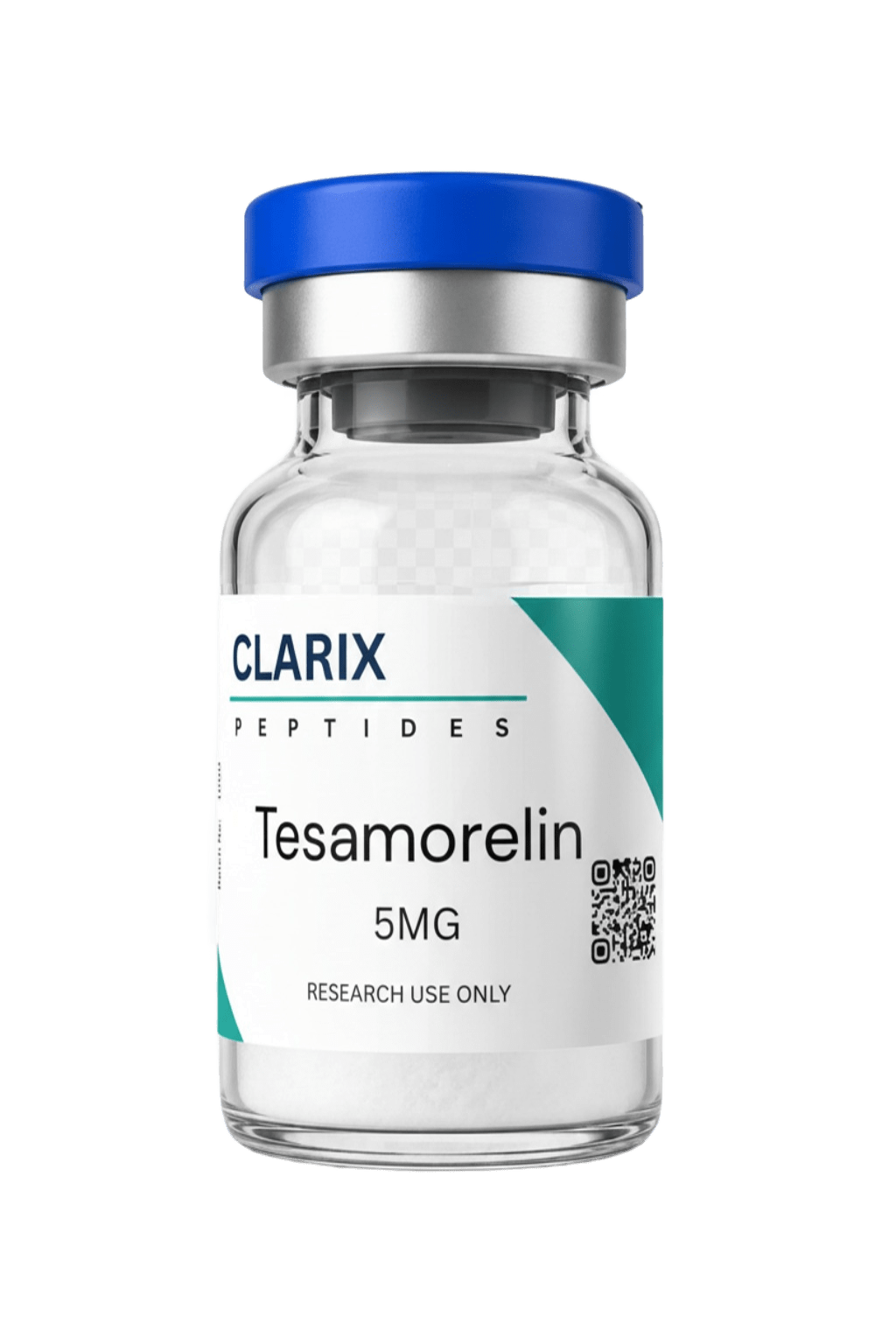
Tesamorelin 2mg — Research Grade
GHRH analogue. HPLC-verified purity. Third-party COA included with every batch. UK dispatch. For laboratory research use only.