CJC-1295 is a modified analogue of growth hormone-releasing hormone (GHRH) that appears in two distinct forms: CJC-1295 with DAC and CJC-1295 without DAC. These are not simply different concentrations of the same compound — they are pharmacologically different research tools with different half-lives, different GH secretion profiles, and different optimal experimental applications. Researchers who conflate the two risk designing protocols that produce misleading data or fail to answer their intended research question.
This guide clarifies exactly what differentiates the two forms of CJC-1295, why the distinction matters for research design, and how Clarix Peptides approaches supply of these compounds. All material is relevant to laboratory research use only.
The GH Axis: Why Researchers Study GHRH Analogues
Growth hormone (GH) is secreted by somatotroph cells in the anterior pituitary gland under the control of two primary hypothalamic regulators: growth hormone-releasing hormone (GHRH), which stimulates GH release, and somatostatin, which inhibits it. In healthy physiology, GH secretion is pulsatile — occurring in discrete bursts most prominently during slow-wave sleep — rather than tonic. This pulsatile pattern is critical for many of GH's downstream effects including IGF-1 production, body composition regulation, and metabolic homeostasis.
Native GHRH is a 44-amino acid peptide released from the arcuate nucleus of the hypothalamus. Its plasma half-life is extremely short — approximately 2 to 4 minutes — due to rapid cleavage by DPP-IV at the Ala-2 position and further degradation by plasma endopeptidases. This instability makes native GHRH impractical as a research tool for anything beyond acute pulse studies. Modified GHRH analogues including CJC-1295 and tesamorelin were developed specifically to overcome this limitation while retaining activity at the GHRH receptor (GHRHR) on pituitary somatotrophs.
CJC-1295 Without DAC: Modified GRF 1-29
CJC-1295 without DAC is also commonly referred to as Modified GRF 1-29 (Mod GRF 1-29) in the research literature, and understanding this naming convention helps researchers correctly identify published studies. The compound is a modified 29-amino acid peptide corresponding to the bioactive N-terminal fragment of GHRH. It incorporates four amino acid substitutions that protect it from DPP-IV cleavage and endopeptidase degradation while preserving full agonist activity at the GHRH receptor.
The result is a plasma half-life of approximately 30 minutes — substantially longer than native GHRH's 2-4 minutes, but still short enough to produce a defined, episodic GH pulse. When administered in a research model, CJC-1295 No DAC produces a rapid rise in GH within 15-30 minutes, reaching peak concentration, then declining over 2-3 hours. This pharmacokinetic profile closely mimics the natural pulsatile pattern of endogenous GHRH action on pituitary somatotrophs and the resulting GH release pattern.
This physiological pulsatility is the principal reason CJC-1295 without DAC is preferred for most current research applications. Continuous or sustained GH elevation — as would occur with very long-acting GHRH analogues — is known to downregulate GHRH receptors on somatotrophs and produce feedback inhibition via somatostatin. Episodic stimulation avoids this desensitisation problem and better models the conditions under which GH's physiological effects occur.
CJC-1295 With DAC: Extended Half-Life via Albumin Binding
CJC-1295 with DAC adds a Drug Affinity Complex (DAC) moiety to the peptide. Specifically, a maleimidoproprionic acid (MPA) linker is attached to the C-terminus of the peptide, which forms a stable thioether bond with the cysteine-34 residue of serum albumin. Because albumin is abundant in plasma and has a half-life of approximately 19 days, this albumin binding dramatically extends the effective half-life of the peptide to approximately 6 to 8 days.
This extended half-life means that a single administration of CJC-1295 with DAC produces sustained, elevated GH and IGF-1 levels for many days rather than the discrete pulse seen with the No DAC form. The resulting GH profile is fundamentally non-pulsatile — it resembles a chronic GH infusion rather than episodic secretion. In a research context, this profile is useful when the experimental objective is to study the effects of chronically elevated GH or IGF-1 over time, or when dosing frequency needs to be minimised in long-duration animal studies.

GH Receptor Kinetics and Desensitisation
One of the most important considerations in choosing between the two CJC-1295 forms is the risk of GHRH receptor desensitisation with sustained agonism. The GHRH receptor, like other G protein-coupled receptors, is subject to downregulation and internalisation following prolonged agonist exposure. When GHRH receptor signalling is chronically stimulated — as occurs with CJC-1295 with DAC over its 6-8 day activity window — receptor density on somatotrophs decreases and GH secretory capacity may be attenuated.
Furthermore, sustained GH elevation feeds back to increase somatostatin tone, which provides additional inhibition of pituitary GH release. Over repeated administrations of CJC-1295 with DAC, these feedback mechanisms could reduce the GH response to each successive dose — a phenomenon known as tachyphylaxis. Researchers designing long-duration studies with CJC-1295 with DAC should account for this possibility in their experimental design and outcome measures.
CJC-1295 without DAC's short half-life avoids sustained receptor agonism and the associated desensitisation risk, making each administration produce a consistent GH pulse — provided adequate inter-dose intervals allow receptor and pituitary recovery.
Why Most Researchers Choose CJC-1295 Without DAC
For the majority of research applications, CJC-1295 without DAC (Modified GRF 1-29) is the more appropriate and more commonly used form. The reasons are both mechanistic and practical:
- Physiological relevance: Pulsatile GH secretion is the normal physiological pattern; No DAC mimics it while DAC does not
- Receptor preservation: Short-acting stimulation reduces receptor desensitisation and somatostatin feedback
- Experimental control: Defined pulse kinetics allow precise timing of GH peak and trough in relation to other experimental variables
- Combination research: No DAC is typically paired with GHRPs for synergistic GH release research — both agents act acutely and produce a characterised combined pulse
- Published literature: The majority of GHRH analogue research published under Modified GRF 1-29 or Mod GRF uses the No DAC form
Clarix Peptides supplies CJC-1295 No DAC (Modified GRF 1-29) as its standard GHRH analogue offering, reflecting the research community's preference for the physiologically relevant pulsatile form. The compound is supplied as a lyophilised powder in sealed vials with HPLC purity verification and a third-party Certificate of Analysis.
Handling, Reconstitution, and Storage
CJC-1295 No DAC is reconstituted using bacteriostatic water or sterile water for injection. As with all GHRH analogues, the reconstituted solution should be prepared carefully: add diluent slowly down the side of the vial to avoid mechanical disruption to the peptide, then swirl gently rather than shaking. Vigorous agitation can promote aggregation and reduce biological activity.
Reconstituted solutions should be stored at 2-8°C (refrigerated) and used within 28 days. The lyophilised powder is more stable and should be stored at -20°C for long-term preservation, with brief room-temperature exposure during reconstitution acceptable. Researchers should protect both forms from direct light and repeated temperature fluctuation. For multi-experiment stocks, aliquoting the reconstituted solution into single-use volumes before freezing helps avoid the degradation associated with repeated freeze-thaw cycles.
Frequently Asked Questions
What does DAC mean in CJC-1295?
DAC stands for Drug Affinity Complex. In CJC-1295 with DAC, a maleimidoproprionic acid (MPA) moiety is covalently attached to the peptide's C-terminus. This moiety reacts with the cysteine-34 residue on serum albumin in plasma, forming a stable thioether bond. Because albumin has a long half-life and is abundant in circulation, this binding dramatically extends CJC-1295's plasma half-life from approximately 30 minutes to 6-8 days, producing sustained rather than pulsatile GH elevation.
Which form of CJC-1295 is more commonly used in research?
CJC-1295 without DAC, also known as Modified GRF 1-29, is more commonly used in research because it produces a physiologically relevant pulsatile GH secretion pattern. Its ~30 minute half-life means it mimics natural GHRH activity at the pituitary, avoids chronic receptor desensitisation, and allows precise temporal control over GH pulse timing in experimental designs. It is also more frequently combined with GHRPs for synergistic GH secretion studies.
How long does CJC-1295 No DAC last in research models?
CJC-1295 without DAC has a plasma half-life of approximately 30 minutes in vivo. Peak GH stimulation in research models is typically observed within 15-30 minutes of administration, with GH levels declining toward baseline over the following 2-3 hours. This acute pharmacokinetic profile makes it suitable for studying episodic GH pulsatility and for protocols where multiple administrations per day are used to simulate physiological GH secretion frequency.
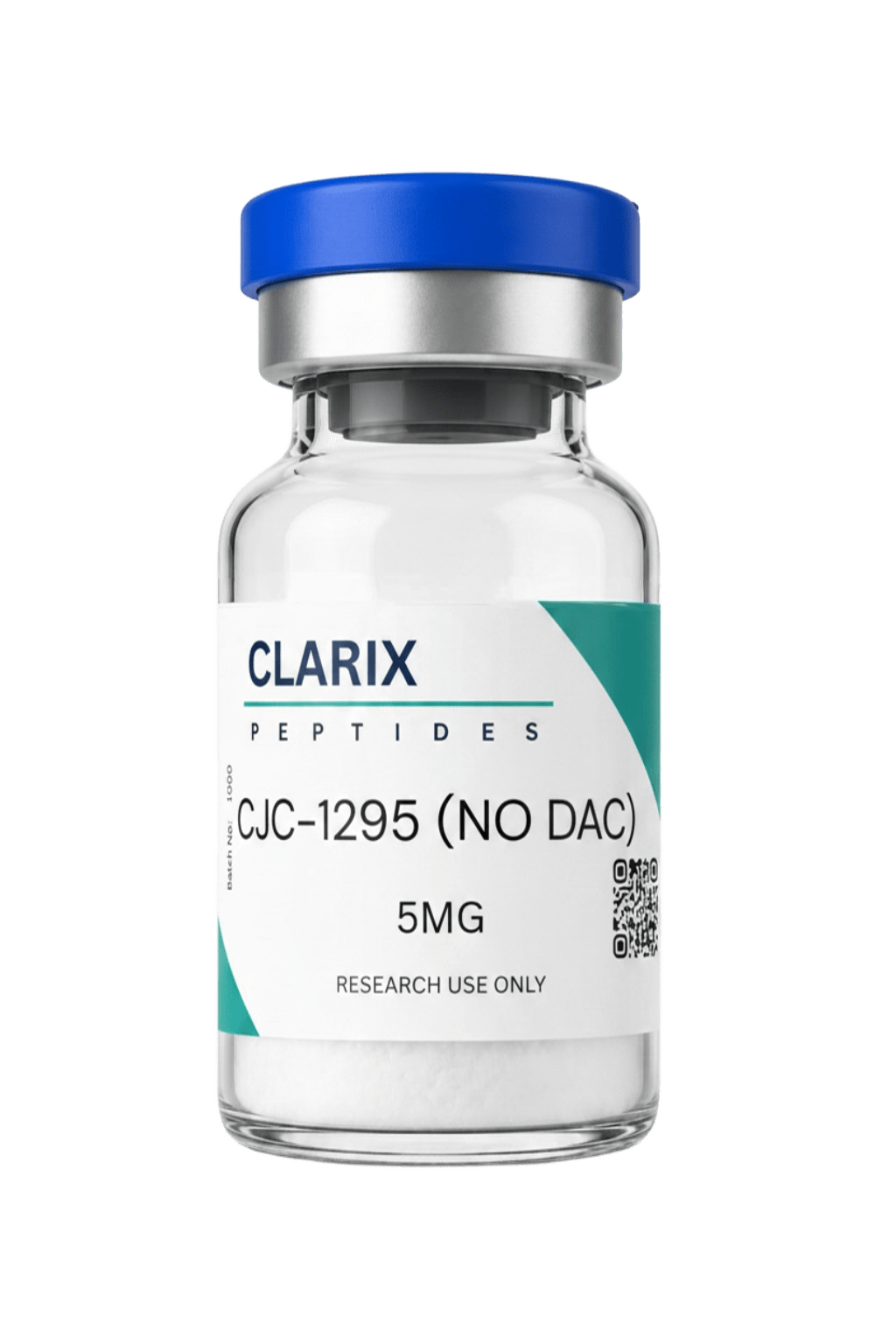
CJC-1295 No DAC 2mg — Research Grade
Modified GRF 1-29. HPLC-verified purity. Third-party COA included. UK dispatch. For laboratory research use only.