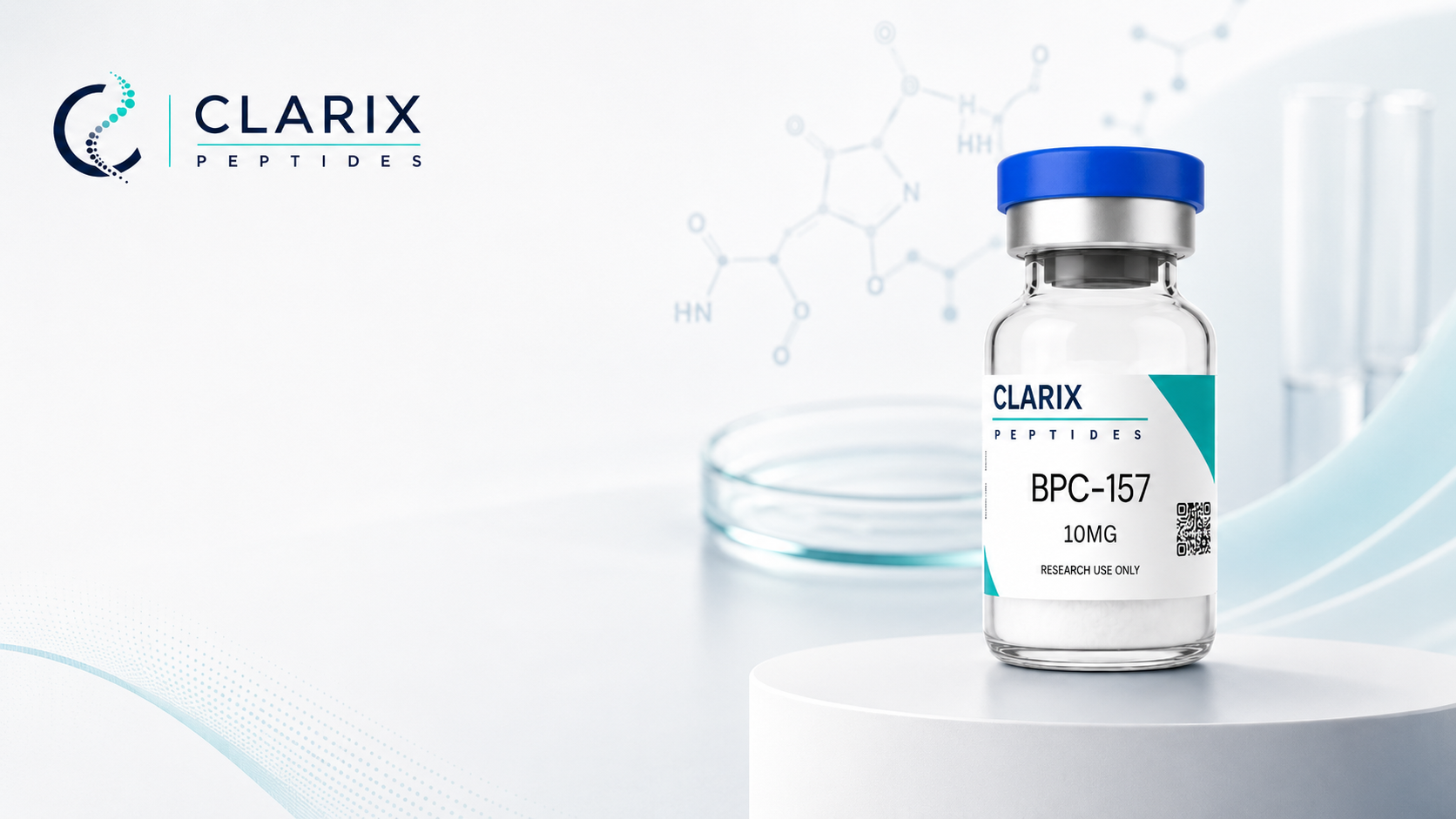
The legal status of research peptides in the UK is a question that comes up regularly among laboratory researchers, academic scientists, and procurement managers. The short answer is that most research peptides are not controlled substances in the UK, and purchasing them for legitimate laboratory research is lawful. However, the regulatory framework they operate within is specific and carries important obligations for both suppliers and buyers. This guide explains the key legal frameworks that apply, what "for research purposes only" means in law, and how reputable UK suppliers like Clarix Peptides operate in compliance with applicable regulations.
This article is provided for information purposes. It does not constitute legal advice. Individuals or organisations with specific compliance questions should seek independent legal counsel.
The UK Legal Framework: Misuse of Drugs Act 1971
The primary legislation controlling dangerous and misused substances in the UK is the Misuse of Drugs Act 1971 (MDA). This Act creates three schedules of controlled substances — Schedule 1 (highest restriction, no recognised medical use), Schedule 2 (high potential for misuse but recognised medical use), and Schedule 3 (lower misuse potential, some medical use) — along with classifications as Class A, B, or C based on harm potential.
Research peptides — including compounds such as BPC-157, TB-500, retatrutide, tesamorelin, ipamorelin, CJC-1295, GHK-Cu, and melanotan II — are not listed in any schedule of the Misuse of Drugs Act. They are not Class A, B, or C substances. Purchasing, possessing, or supplying them is not a criminal offence under the MDA in the United Kingdom, provided they are handled in a lawful manner consistent with their research-use-only designation.
It is worth noting what the MDA does control that is adjacent to this space: anabolic steroids (such as testosterone and nandrolone) are Class C substances under Schedule 4 Part II. GH (somatropin) is Schedule 4 Part II. These are distinct from peptides and are subject to separate regulatory restrictions. Peptide compounds are categorically different from synthetic anabolic steroids and endogenous hormones, and this distinction matters significantly from a legal standpoint.
MHRA Classification: Research Chemicals vs Medicinal Products
The second key regulatory framework is administered by the Medicines and Healthcare products Regulatory Agency (MHRA), the UK body responsible for regulating medicines and medical devices. The MHRA's central function in the context of research peptides is the distinction between a medicinal product and a research chemical.
Under UK medicines law (principally the Human Medicines Regulations 2012, implementing retained EU law), a medicinal product is defined as a substance presented as having properties of treating or preventing disease in human beings, or administered to restore, correct, or modify physiological functions. A product meeting this definition requires a Marketing Authorisation (MA) from the MHRA before it can be placed on the market in the UK. Supplying a product that meets the definition of a medicinal product without an MA is unlawful under UK medicines law.
Research peptide suppliers — including Clarix Peptides — do not hold Marketing Authorisations for the compounds they supply, and do not present those compounds as medicines. Research peptides are supplied as research chemicals for in-vitro and preclinical laboratory use only. Under this model, the supplier is not making medicinal claims, is not providing dosing guidance for human use, and is not supplying a product intended for human administration. This is the basis on which the research peptide supply model operates within UK law.
The MHRA does have the power to review whether products are being presented or marketed in a manner that meets the medicinal product definition — which is why responsible UK suppliers are careful to ensure their marketing, website content, and customer communications do not imply human therapeutic use.
What "For Research Purposes Only" Means Legally
The phrase "for research purposes only" (or "for laboratory research use only") is a legal designation with specific implications for both suppliers and buyers. It is not simply a disclaimer — it defines the lawful scope of supply and use.
When a compound is sold as a research-use-only chemical:
- The supplier is representing that the product is not a medicinal product and has not been produced under GMP (Good Manufacturing Practice) standards required for human-use medicines
- The supplier is not providing medical advice, dosing guidance, or any information intended to facilitate human self-administration
- The buyer accepts that the compound is being purchased for lawful in-vitro or preclinical research use only
- Neither party represents that the compound is safe or suitable for human administration
- The buyer takes responsibility for ensuring use is confined to the lawful research context in which purchase was made
The legal protection of this model depends entirely on both parties genuinely operating within its scope. A buyer who purchases a research peptide with the intention of self-administration is not operating within the research-use-only framework and cannot rely on that framework for any legal protection. Similarly, a supplier who provides dosing advice, administration guidance, or markets products in a way that implies human therapeutic use undermines the lawful basis of the supply model.

Who Can Legally Purchase Research Peptides in the UK
There is no specific licence requirement in the UK for purchasing research peptides for in-vitro or preclinical research — unlike, for example, Schedule 1 controlled drugs which require a Home Office licence. Purchasers do not need a specific research peptide licence or MHRA authorisation to buy these compounds.
However, responsible suppliers should confirm that purchasers are acquiring compounds for genuine research purposes. Common purchaser profiles for research peptides include:
- Academic researchers at universities or research institutes
- Commercial pharmaceutical or biotech companies conducting preclinical research
- Contract research organisations (CROs) conducting in-vitro or animal model studies
- NHS or private research institutions with defined research programmes
- Independent qualified researchers with documented research objectives
At Clarix Peptides, our terms and conditions require buyers to confirm that purchases are made for legitimate research use only. We do not supply to individuals who indicate intended human or veterinary administration.
Psychoactive Substances Act 2016
Researchers should also be aware of the Psychoactive Substances Act 2016 (PSA), which broadly prohibits the supply of any substance capable of producing a psychoactive effect — defined as affecting a person's mental function or emotional state. The PSA was introduced primarily to close the "legal high" loophole that allowed novel psychoactive substances to be sold as long as they were not specifically scheduled under the MDA.
Peptides of the types typically researched — BPC-157, TB-500, GHRH analogues, GLP-1 analogues, and similar compounds — do not produce psychoactive effects and are not supplied for any purpose related to psychoactive use. They therefore do not fall within the scope of the PSA. The PSA also contains exemptions for medicinal products and research compounds used in lawful research. Clarix Peptides operates in full compliance with the PSA.
UK vs EU: Post-Brexit Divergence
Since the UK's departure from the European Union, UK medicines and research chemical regulation operates independently of EU frameworks. The EU's equivalent to the MHRA is the European Medicines Agency (EMA), and EU member states have their own national regulatory bodies (e.g., BfArM in Germany, ANSM in France). Regulatory treatment of research peptides varies significantly by EU member state — some apply stricter interpretations of the medicinal product definition, while others operate similarly to the UK model.
UK-based researchers importing research peptides from EU or other international suppliers should be aware that UK customs authorities may apply their own assessment of whether imported compounds require specific documentation or are subject to import restrictions. Sourcing from a UK-based supplier — such as Clarix Peptides — avoids these import complexities and ensures the compounds are held and dispatched under UK regulatory standards with no cross-border documentation requirements.
How to Buy Research Peptides Legally in the UK
For UK-based researchers, the following criteria should guide the selection of a research peptide supplier:
- Clear research-use-only terms: The supplier should explicitly state compounds are for research use only and should not make medicinal claims
- Third-party purity documentation: HPLC purity results and Certificates of Analysis from accredited laboratories confirm compound identity and quality
- No human-use dosing guidance: Reputable suppliers do not provide advice on dosing, administration routes, or protocols for human self-use
- UK-based operations: UK-based stock and dispatch avoids import complications and ensures regulatory framework consistency
- Transparent business identity: The supplier should be a registered UK company with publicly available contact details
Clarix Peptides is a UK-based research peptide supplier operating in full compliance with applicable UK law. We hold HPLC-verified, third-party tested stock and supply only to verified research purchasers under our research-use-only terms. Our Certificates of Analysis are available for every batch and can be provided on request or included with each order.
Frequently Asked Questions
Are research peptides legal to buy in the UK?
Research peptides are not controlled substances under the Misuse of Drugs Act 1971 in the UK. Purchasing them for legitimate in-vitro or preclinical laboratory research is lawful. They are not licensed medicinal products, which means they must not be sold for or used in human administration. The legal basis for research peptide supply is the research-chemical model: compounds sold strictly for lawful laboratory research use only, with no medicinal claims made by the supplier.
Do I need a licence to buy research peptides in the UK?
No specific licence is required to purchase research peptides in the UK for in-vitro or preclinical research. They are not Schedule 1 controlled substances requiring a Home Office licence, nor are they licensed medicines requiring a prescription. However, buyers should be able to confirm a genuine research purpose if asked by a supplier, and should ensure use is confined to lawful research contexts. Purchasing for personal human use is not within the lawful scope of the research-chemical supply model.
What does "for research purposes only" mean legally?
"For research purposes only" is a legal designation indicating the compound is a research chemical, not a medicinal product. It means the supplier does not hold a MHRA Marketing Authorisation for the compound, does not present it as a medicine, and does not provide human-use guidance. The buyer accepts responsibility for ensuring use is limited to lawful research. Human administration is explicitly outside the scope of this designation and is not covered by the legal framework governing research chemical supply.
Research Peptides from a Compliant UK Supplier
Clarix Peptides operates under strict research-use-only terms. HPLC-verified purity, third-party COA, UK dispatch. For laboratory research use only.