BPC-157 and TB-500 are two of the most extensively researched repair-focused peptides in preclinical science. Both appear in the literature across musculoskeletal, wound healing, and tissue regeneration research models, and both are frequently discussed together — yet they are mechanistically distinct compounds with different origins, different primary research targets, and different strengths depending on the experimental model. This article provides a thorough side-by-side comparison for researchers evaluating which compound — or which combination — best serves their experimental objectives.
Neither BPC-157 nor TB-500 is approved for human or veterinary therapeutic use. All discussion here pertains strictly to preclinical research contexts. Clarix Peptides supplies both compounds as research-grade lyophilised peptides for laboratory use only.
BPC-157: Origins and Mechanism
BPC-157 — Body Protection Compound 157 — is a synthetic 15-amino acid pentadecapeptide derived from a naturally occurring protein found in human gastric juice. The parent protein, Body Protection Compound (BPC), was identified in the 1990s by researchers at the University of Zagreb exploring the gastric mucosa's intrinsic cytoprotective mechanisms. BPC-157 represents a stable, isolated fragment of this protein with enhanced stability compared to native gastric BPC.
The compound's primary research interest lies in its interaction with the nitric oxide (NO) system. BPC-157 has been shown in multiple rodent studies to modulate endothelial nitric oxide synthase (eNOS) and neuronal nitric oxide synthase (nNOS) activity, influencing local vascular tone and tissue perfusion at sites of injury. The NO pathway connects to downstream effects including promotion of angiogenesis, fibroblast proliferation, and collagen synthesis — all critical components of tissue repair cascades.
BPC-157 is also studied for its interaction with growth factor signalling, particularly involving VEGF (vascular endothelial growth factor) and EGF (epidermal growth factor) receptors. These interactions may contribute to the compound's cytoprotective effects in gastrointestinal models, where it has been extensively evaluated in gastric ulcer, inflammatory bowel, and intestinal permeability research. In the GI tract, BPC-157 appears to accelerate mucosal regeneration and reduce inflammation in several rodent colitis and ulcer models.
BPC-157 in Musculoskeletal Research
Outside of the GI system, BPC-157 has been evaluated in tendon, ligament, and bone repair models. Studies in rodents have assessed Achilles tendon transection, cruciate ligament damage, and cortical bone injury. In these models, BPC-157 administration has been associated with accelerated histological healing markers, increased collagen organisation, and improved biomechanical testing outcomes. The compound's ability to modulate local NO production at injury sites is thought to underpin many of these musculoskeletal effects.
TB-500: Origins and Mechanism
TB-500 is a synthetic peptide corresponding to amino acids 17–23 of thymosin beta-4 (Tβ4), an actin-binding protein originally isolated from bovine thymus tissue in 1981. Thymosin beta-4 is a 43-amino acid protein highly conserved across mammalian species and expressed in virtually all nucleated cells. Its primary biological role is sequestration of actin monomers (G-actin), regulating the pool of free actin available for filament polymerisation and thereby influencing cell motility, cytoskeletal dynamics, and tissue remodelling.
The research-active fragment TB-500 contains the actin-binding domain of thymosin beta-4. By modulating actin availability, TB-500 influences a wide range of cellular processes including cell migration, wound closure, differentiation of stem cells, and formation of new blood vessels. The compound has been studied in models of cardiac repair, skeletal muscle injury, dermal wound healing, and corneal repair.
A particularly distinctive feature of TB-500's mechanism is its pro-angiogenic activity. In preclinical models, thymosin beta-4 and its active fragment have consistently promoted endothelial cell migration and new vessel formation — effects mediated in part through upregulation of VEGF and activation of the PI3K/Akt signalling pathway. This angiogenic capacity makes TB-500 a useful research tool in models where new vascular supply is a limiting factor in tissue regeneration.
TB-500 in Cardiac and Muscle Research
Thymosin beta-4 has attracted particular interest in cardiac repair research following myocardial infarction models in rodents. Published studies have reported that Tβ4 administration promotes cardiomyocyte survival, reduces fibrotic scar formation, and stimulates endogenous cardiac progenitor cell activation. In skeletal muscle injury models, TB-500 has been associated with accelerated satellite cell migration to injury sites and improved muscle fibre regeneration metrics. These systemic, cell-migration-oriented effects distinguish TB-500 from the more locally-focused repair mechanisms of BPC-157.
Key Mechanistic Differences
The most fundamental mechanistic distinction between BPC-157 and TB-500 is the axis through which each compound acts. BPC-157 operates primarily through the nitric oxide system and growth factor receptor modulation, producing effects that are often characterised as local and pleiotropic — concentrated at injury sites where NO-driven vascular and tissue responses are initiated. TB-500 operates primarily through actin sequestration and cytoskeletal regulation, with downstream effects on cell migration and angiogenesis that are inherently systemic in nature — wherever cells capable of migration exist, TB-500's actin-modulating effects may be active.
This distinction has practical implications for research model design. For models focused on discrete local injury — a specific tendon lesion, a defined area of mucosal damage, a localised nerve injury — BPC-157's local NO and growth factor effects may be more directly relevant. For models where systemic cellular recruitment, new vessel formation across a tissue bed, or myocardial recovery from ischaemia are the primary endpoints, TB-500's cell-migration and angiogenic mechanisms are the more targeted research choice.
BPC-157 vs TB-500: Focus Areas Compared
- GI mucosal healing: BPC-157 has extensive literature; TB-500 has minimal direct GI focus
- Tendon and ligament repair: BPC-157 has the larger published dataset; TB-500 has some supporting data
- Cardiac muscle repair: TB-500/Tβ4 has the larger and more specific literature; BPC-157 has some cardiovascular data
- Angiogenesis: TB-500 is the primary research tool; BPC-157 has secondary angiogenic effects via NO
- Neuroprotection: BPC-157 has published data in spinal cord and peripheral nerve models; TB-500 has limited CNS literature
- Dermal wound healing: Both have published preclinical data; Tβ4 data is more extensive
- Skeletal muscle: TB-500 has specific satellite cell and muscle fibre data; BPC-157 has supporting data
Co-Administration in Research: The Case for Combining Both
Given their complementary mechanisms, BPC-157 and TB-500 are one of the most commonly co-administered peptide pairs in tissue repair research. The rationale is straightforward: BPC-157 addresses local repair signalling and GI integrity at the injury site while TB-500 simultaneously promotes systemic cell migration and new vascular formation to support the repair zone. Together, they address both local and systemic components of the healing response.
Published combination studies in rodent models have generally reported additive or at minimum non-antagonistic effects. Researchers designing models that aim to replicate a maximal repair environment — or that seek to characterise whether local versus systemic mechanisms contribute differently to healing speed and quality — frequently include both compounds as separate arms or as a combined arm alongside individual compound arms.
Clarix Peptides supplies both BPC-157 5mg and TB-500 5mg as research-grade lyophilised compounds with HPLC-verified purity and third-party Certificates of Analysis. Sourcing both from a single supplier ensures batch documentation consistency across co-administration experiments.
Handling and Storage Comparison
Both BPC-157 and TB-500 are supplied as lyophilised white powders and are reconstituted with bacteriostatic water or sterile saline for research use. BPC-157's stability in aqueous solution is moderate; reconstituted solutions should be refrigerated at 4°C and used within 28 days. The lyophilised powder is stable at room temperature for short periods but should be stored at -20°C for long-term preservation.
TB-500 follows a similar storage profile. Reconstituted TB-500 is stable at 4°C for up to 4 weeks. Both compounds should be protected from repeated freeze-thaw cycles in their reconstituted form, as this degrades peptide integrity over successive cycles. Researchers working with both compounds simultaneously benefit from documenting batch numbers independently for each, as this supports reproducibility in multi-compound experimental designs.
Frequently Asked Questions
What is the difference between BPC-157 and TB-500?
BPC-157 is a 15-amino acid peptide derived from a human gastric juice protein, primarily researched for its effects on GI mucosal healing, tendon repair, and neuroprotection through nitric oxide pathway modulation. TB-500 is a synthetic fragment of thymosin beta-4, a 7-amino acid peptide primarily studied for its role in actin dynamics, cellular migration, and angiogenesis. Both are used in tissue repair research but through distinct mechanisms and with different primary research focus areas.
Can BPC-157 and TB-500 be used together in research?
Yes. Co-administration of BPC-157 and TB-500 is one of the most common peptide combination approaches in preclinical tissue repair research. Their mechanisms are complementary rather than redundant: BPC-157 addresses local NO-driven repair and GI cytoprotection while TB-500 promotes systemic cell migration and new vessel formation. Published rodent studies support the non-antagonistic co-administration of these compounds in musculoskeletal and wound healing models.
Which peptide is studied more for tendon repair?
BPC-157 has the larger and more specific published literature on tendon repair, with multiple rodent studies evaluating Achilles tendon, patellar tendon, and rotator cuff models. TB-500 has supporting literature in musculoskeletal contexts but with a broader systemic focus. Researchers specifically targeting tendon or ligament healing mechanisms will typically find the BPC-157 literature more directly applicable to their experimental design.
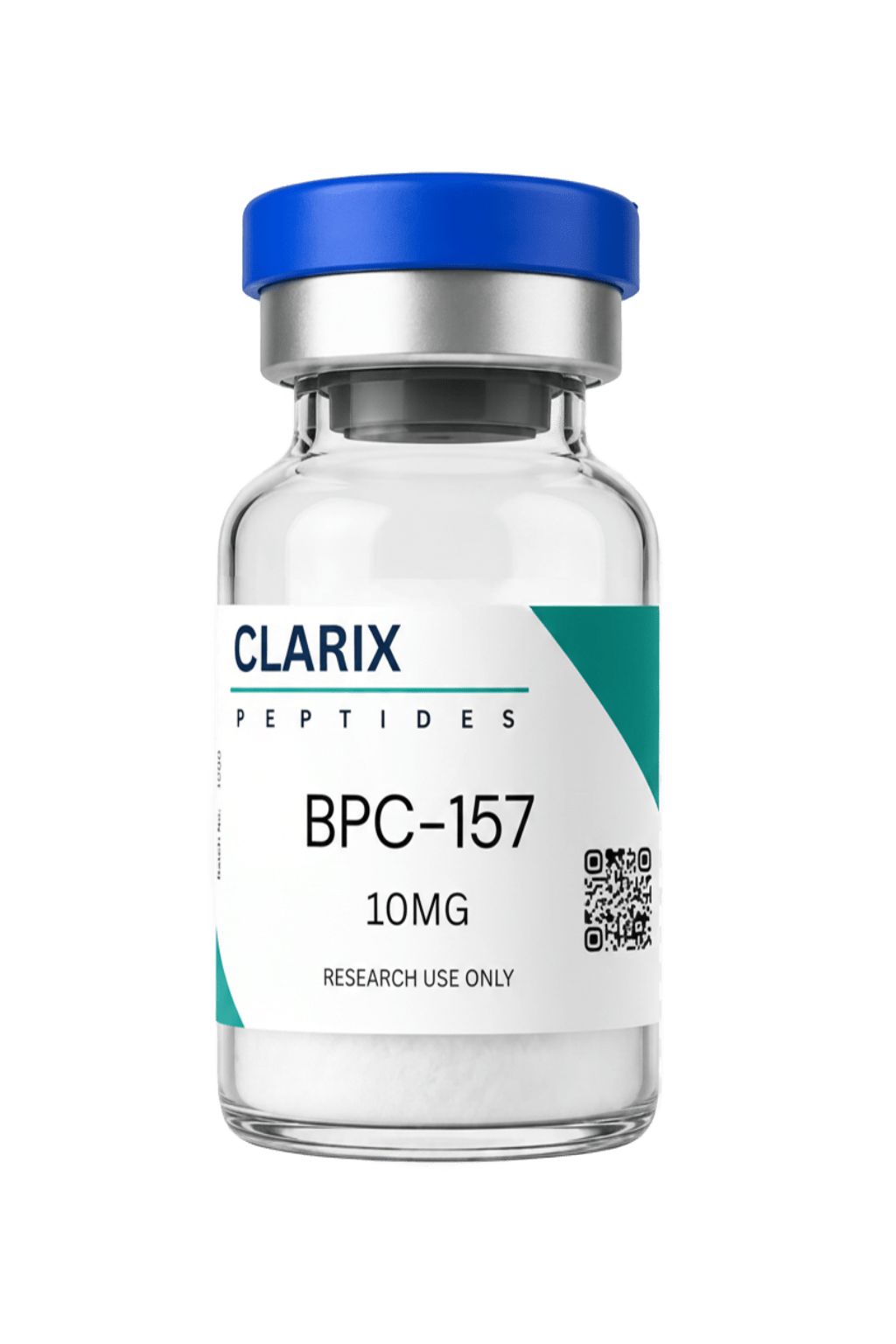
BPC-157 5mg — Research Grade
HPLC-verified purity. Third-party COA included. Also available: TB-500 5mg. UK dispatch. For laboratory research use only.